
The New Machzor of the Reform Movement
Inspiration, Tradition, Innovation
About Mishkan HaNefesh
- Offers meaningful liturgy for both regular service attendees and those new to Jewish spirituality and practice
- Inspires a multifaceted experience of Yamim HaNoraim—from feelings of awe to moments of solace, from the solitude of contemplation to the solidarity of song and worship
- Provides an accessible guide through the journey of t’shuvah (repentance) and cheshbon hanefesh (self-reflection)
- Bridges the personal and the communal, the ritual and the ethical dimensions of Yamim HaNoraim
- Embraces the rich liturgical voices of the Jewish past and the aspirations of our people today
Special Features
- Fully transliterated liturgy
- Expanded options for Torah readings
- Study texts that provide background and context
- Contemporary poetry and alternative readings
- Rich commentary drawing from Jewish tradition
- A range of theological possibilities
- New translations that capture the beauty of the Hebrew
- Original woodblock art by acclaimed artist Joel Shapiro
- Includes essays by the leading Reform Movement thinkers
For more information, please write to info@ccarpress.org or call 212-542-8796.
About Mishkan HaNefesh >
| Why do we need a new machzor? Gates of Repentance has served the Reform Movement well for many years. When it was first published in 1978, it represented exciting and progressive liturgical innovation. However, today it is beginning to feel dated. Congregations that use Mishkan T’filah are ready for a machzor that serves as a companion to the approach of the new siddur. The fact that it does not include transliteration is a stumbling block for many in our communities. So too, many of today’s Jews feel disconnected from prayer and from theological and ideological concepts that do not seem consistent with a contemporary sensibility. Like Mishkan Tfilah, Mishkan HaNefesh makes strides towards a multi-vocality that creates a space for all to inhabit, offering a multiplicity of different approaches. Through updated translations, elucidating essays, rich commentary, and a beautiful selection of poetry, Mishkan HaNefesh provides an environment for those of all backgrounds to find meaning in the High Holy Days. Ten Essential Things You Need to Know about Mishkan HaNefesh Frequently Asked Questions About Mishkan HaNefesh |
| Why should we switch to Mishkan HaNefesh? Gates of Repentance was a wonderful innovation in its time. Incorporating more Hebrew and traditional liturgy allowed for a feeling of renewed tradition in the High Holy Days. Adding gender-neutral language addressed many of the contemporary needs of the Reform world. Today, our needs go beyond gender neutral language – the basic meaning of the holidays needs to be addressed and updated. Mishkan HaNefesh gives both the prayer leader and the community a wealth of resources for finding new meaning in these High Holy Days. Through updated translations, readings, and poetry, as well as easily accessible transliteration and new liturgical innovations, Mishkan HaNefesh breathes new life into High Holy Day services. |
| Many people in our community have strong emotional attachments to Gates of Repentance. How can we encourage the change? Gates of Repentance will live on through the multi-vocality of Mishkan HaNefesh. Many of the readings and liturgical developments that first appeared in Gates of Repentance have found their way into Mishkan HaNefesh. By including these selections alongside new material, Mishkan HaNefesh allows for service leaders to design services by selecting from among different elements that will speak most strongly to their individual communities. |
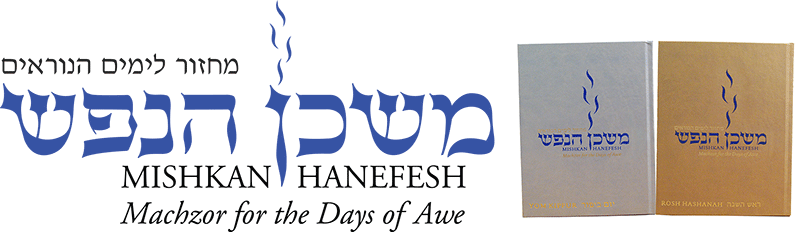
| How many volumes is Mishkan HaNefesh? The standard edition Mishkan HaNefesh is a two volume set – with a gold cover for Rosh HaShanah and a silver one for Yom Kippur. |
| Are other editions available? A large print set is available. It is a three volume paperback set, created to be large enough for ease of reading but not too heavy to hold. A pulpit edition for rabbis and cantors is also available. This set is two volumes, hard bound, and larger than the regular set. |
| Is there a digital version? Mishkan HaNefesh Kindle eBook is now available for all devices except Kindle Paperwhite. Visit the Mishkan HaNefesh product page to download your Kindle eBook. |
| Is there a Visual T’filah version of Mishkan HaNefesh? Yes. Mishkan HaNefesh services are available as Visual T’filah ™ . A complete set of Rosh HaShanah services is available in Pro and Basic versions. A complete Yom Kippur set is also available in Pro and Basic versions. We also offer All Pro and All Basic versions which contain the services for both holidays. These products are priced by community size. |
| Is there a musical companion? The compendium of new musical compositions, Shirei Mishkan HaNefesh: An Anthology of Music for the High Holy Days, developed by the American Conference of Cantors in partnership with the CCAR Press, reflects the same core values as Mishkan HaNefesh. Like the new machzor, this collection of original musical compositions gives voice to new liturgy and expands upon the familiar themes that have remained with us from generation to generations. A great High Holy Day resource! The price includes two copies of the volume for the service leader and the accompanist. Table of Contents for Shirei Mishkan HaNefesh: An Anthology of Music for the High Holy Days |
| Is there a companion for S’lichot and the month of Elul? Now available is Mishkan HaLev: Prayers for S’lichot and the Month of Elul, a companion to Mishkan HaNefesh that will help communities to better prepare for the Days of Awe through the month of Elul. Miskhan HaLev offers two complete services, one for Erev Shabbat during the month of Elul, and a S’lichot service. The volume is fully transliterated. |
| Was Mishkan HaNefesh piloted? From 2011 to 2014, over 300 congregations, as well as chavurot, Hillel groups, and day schools, participated in piloting opportunities. Feedback from these congregations continues to have a significant impact on Mishkan HaNefesh. This is a machzor made by the collective Reform Movement for the collective Reform Movement. |
| Why are the translations in Mishkan HaNefesh different than those used in Mishkan T’filah? The High Holy Days are unique, special days with their own themes and significance. Thus the translations for these days are also unique and highlight the special themes and mood of the High Holy Days. For more on the translation approach of Mishkan HaNefesh, see the translation exercise under “Study Resources” (below). |
| Why is the Rosh HaShanah morning Shofar service different in Mishkan HaNefesh than it was in Gates of Repentance? The rationale for splitting up the Shofar service into its three thematic sections is to increase the drama and uniqueness of these moments by weaving them throughout the service. Also, having the three separate sections provides an opportunity for focusing on each of the three unique themes, without having to rush through them, allowing these important central motifs to infuse the service. Separated in this way, the Shofar sections become points of focus during the Rosh HaShanah service, and serve as a beautiful passageways throughout the morning liturgy. Because the Shofar service is traditionally part of musaf, which is not included in Reform liturgy, the current placement in Gates of Repentance is already a Reform innovation. |
| What Torah readings are included in Mishkan HaNefesh? There are several options available for each service, including familiar options from Gates of Repentance and some new options. Some of the Torah readings are included within the service, and some are included in the back of the volume as alternative options. For the Yom Kippur volume, it is possible to choose which reading to do in the morning and which in the afternoon. See here for more specific information about the Torah readings. |
| There is a lot of material in each service. How can we create meaningful experiences while keeping the timing realistic? Service leaders have to choose how to best shape the service for their specific communities. This applies to the choices of readings, as well as music. We asked clergy teams from different congregations to look at one service from Mishkan HaNefesh and create a sample outline showing what choices they would make to shape the experience for their community. Our colleagues generously agreed to do so, and the samples are provided below. We know that switching to a new prayerbook can present some challenges. It is our hope that these outlines will inspire you to determine what would be the right choices to make for your own community. Mishkan HaNefesh Sample Outlines |
| There is a lot of material on each page and on each spread. Will people get distracted? The editors of Mishkan HaNefesh accepted as a given that not everyone will follow the exact path set by the leader. Some people may be moved by a particular reading and linger on that page. Some may become interested in a section of sublinear commentary, or inspired by a meditation, and wind up moving through the service at their own pace. We encourage that kind of personal engagement with the material in Mishkan HaNefesh, and hope that everyone will find something within the covers of the prayerbook that will pique their curiosity or stir their soul. Particpants are encouraged to discover personal connections within Mishkan HaNefesh by exploring the texts on their own. |
| What is included in the Yom Kippur Minchah service? This service is primarily the Yom Kippur afternoon Torah service. It focuses on the concept of midot as an organizing principle for study and reflection, using seven midot or ethical qualities. The service does not include Avodah, Eleh Ezkarah, Yizkor, which appear in the machzor as separate rubrics. |
| What is unique about the Avodah service? This service asks the question: what does Avodah mean to us today? What are the enduring connections that can be found through Avodah? Through the use of texts, readings, and liturgy, participants are encouraged to reflect on our hunger for the spiritual, our ability to continue to grow and develop, our expressions of gratitude, our confessions of sins, and our preparation to begin again. |
| What is unique about the Yizkor service? The Yizkor service in Mishkan HaNefesh uses poetry as a way to approach grief. This Yizkor service offers options for silent, individual reflection; for music and song; for shared congregational prayer; and for individual voices. This service references many forms of grief and many kinds of relationships. Individuals are encouraged to find their own way through the experience of memory and loss even as the leader serves as a caring guide. |
| Are Shabbat insertions included? Yes, Shabbat insertions are clearly indicated where relevant. |
| How does Mishkan HaNefesh direct ritual choreography? Different communities have different traditions regarding when to stand, when to sit, and when to read responsively. Mishkan HaNefesh has left these options open to each community to decide on their own. Following in the tradition of Mishkan T’filah, Mishkan HaNefesh invites communities to take ownership over their services in new ways and does not indicate when to stand or sit. Also like Mishkan T’filah, Mishkan HaNefesh does not use italics to indicate responsive readings. Many readings, however, are designed to offer responsive reading as an option by providing indented paragraphing between segments. |
| Machzor Advisory Group and Editorial Team See the roster here. |
Ordering Mishkan HaNefesh >
| When was Mishkan HaNefesh published? Mishkan HaNefesh was published in June 2015. |
| How much does Mishkan HaNefesh cost? Please view the Mishkan HaNefesh product website for details. |
| Is it possible to have the books printed with customized dedications? Unfortunately, that is not a financially feasible option. However, we created a bookplate template for congregations to customize and print. Please follow the instructions: 1. Download this template page 2. Add your dedication 4. Print using Avery labels number 5168, 3 ½’’ x 5’’ |
Study Resources for Mishkan HaNefesh >
We are happy to offer a free, five session curriculum, prepared by Andrue Kahn and Rabbi April Peters, to help you introduce Mishkan HaNefesh to your community. Sessions are as follows:
– Lesson One: Welcome to Mishkan HaNefesh
– Lesson Two: Shofarot, A New Approach
– Lesson Three: Avinu Malkeinu, Machzor and Metaphor
– Lesson Four: Sin and Forgiveness in the 21st Century
– Lesson Five: Wrestling with Untaneh Tokef
View and download our Mishkan HaNefesh Curriculum
Machzor Mentors
We are pleased to let you know that a number of colleagues have agreed to serve as “machzor mentors” to those of you who are beginning the process of introducing Mishkan HaNefesh to your communities for use in the 2016 High Holy Day season. They have generously agreed to be available by phone or email to share their experience in preparing themselves and their communities. Please contact us for more information.
CCAR Press Related Titles
Mishkan HaLev: Prayers for S’lichot and the Month of Elul
Mishkan HaNefesh for Youth: A Machzor for Youth and Families
Divrei Mishkan HaNefesh: A Guide to the CCAR Machzor
Machzor: Challenge and Change, Volume 1
Machzor: Challenge and Change, Volume 2
Gates of Awe: Holy Day Prayers for Young Children
Gates of Repentance for Young People
Webinars about Mishkan HaNefesh
A New Machzor: A Mystery No More, Part 1, Part 2
Pilot Preparatory Call – August 27, 2012
RavBlog posts
Visit RavBlog for posts about Mishkan HaNefesh.
Additional Resources
Translation Exercise
Torah Readings – What, When, and Why
10 Essential Things You Need to Know about Mishkan HaNefesh
CCAR Summer 2013 Journal: Preparing for the New Machzor
Order the CCAR Summer 2013 Journal
Bringing Mishkan HaNefesh into Your Community >
| Why should we switch to Mishkan HaNefesh? Gates of Repentance was a wonderful innovation in its time. Incorporating more Hebrew and traditional liturgy allowed for a feeling of renewed tradition in the High Holy Days. Adding gender-neutral language addressed many of the contemporary needs of the Reform world. Today, our needs go beyond gender neutral language – the basic meaning of the holidays needs to be addressed and updated. Mishkan HaNefesh gives both the prayer leader and the community a wealth of resources for finding new meaning in these High Holy Days. Through updated translations, readings, and poetry, as well as easily accessible transliteration and new liturgical innovations, Mishkan HaNefesh breathes new life into High Holy Day services. |
| How to honor emotional attachment to Gates of Repentance while encouraging change? Gates of Repentance will live on through the multi-vocality of Mishkan HaNefesh. Many readings and liturgical developments first found in Gates of Repentance have found their way into Mishkan HaNefesh. By including these pieces of Gates of Repentance alongside new material, Mishkan HaNefesh allows for clergy to design services by selecting from different elements that will speak most strongly to their individual communities. Simultaneously, individuals are invited to discover their connections and voice within Mishkan HaNefesh by exploring the texts on their own. |
| Is there a Visual T’filah ™ version of Mishkan HaNefesh? Yes. Mishkan HaNefesh services are available as Visual T’filah ™ . A complete set of Rosh HaShanah services is available in Pro and Basic versions. A complete Yom Kippur set is also available in Pro and Basic versions. We also offer All Pro and All Basic versions which contain the services for both holidays. These products are priced by community size. |
| Will it be possible to have the books printed with customized dedications? Unfortunately, that is not a financially feasible option. However, we created a bookplate template for congregations to customize and print. Please follow the instructions: 1. Download this template page 2. Add your dedication 4. Print using Avery labels number 5168, 3 ½’’ x 5’’ |
| Are there promotional materials available? |
Yes, following are promotional materials:
18 Top Reasons to Buy Mishkan HaNefesh
Ten Essential Things You Need to Know about Mishkan HaNefesh
Visual Promotional Material:
Please right click on the JPEGs below to download and save each image.
Mishkan HaNefesh Banner – JPEG
Mishkan HaNefesh Cover Images – JPEG
Customize Your Own Mishkan HaNefesh Flyer:
Template for Mishkan HaNefesh Flyer – Landscape Oriented
Template for Mishkan HaNefesh Flyer – Portrait Oriented
Promotional Material and Congregational Strategies for Introducing Mishkan HaNefesh:
Compilation of Mishkan HaNefesh Congregational Videos for All Communities
Mishkan HaNefesh Comic Strip from Temple Emanu-El of Westchester
Customized Mishkan HaNefesh Bulletin from Temple Isaiah of Lafayette, CA
Tzedakah at The Temple (Atlanta, GA) – Dedicate a copy of Mishkan HaNefesh
Exciting videos from Temple Emanu-El in Dallas, Texas, introducing Mishkan HaNefesh
Excerpt from 2015 HHD Brochure, Temple Sinai of Sandy Springs, GA
Temple Sinai of Roslyn Heights, NY, “New Prayer Books for the High Holy Days,” excerpted from September 2015 Bulletin
Rabbi Debra J. Robbins’ “My Machzor” featured in Temple Emanu-El’s The Window, October 2014
From the Media >
” 7 Jewish Feminist Highlights of 2015” – Lilith, December 22, 2015
“A New Prayer Book for a New Year” – Jewish Standard, September 17, 2015
“Time for an Upgrade: Innovation Meets Tradition in New Reform Machzor” – J Weekly, September 17, 2015
“New Jewish Prayer Book for Rosh HaShanah and Yom Kippur” – Minneapolis Star Tribune, September 9, 2015
“Wave of new holiday prayer books changing the ways to worship” – JTA
“Revised Jewish prayer book speaks to gay equality, women and doubt” – The Washington Post
“For Reform, new gay-friendly High Holidays prayer book keeps up inclusivity trend” – JTA
“Reform Movement unveils new gay-friendly High Holy Days prayer book” – Haaretz
“Revamped prayer book offers modern take for Reform Jews” – Boston Herald