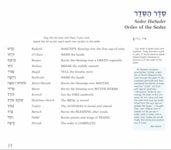
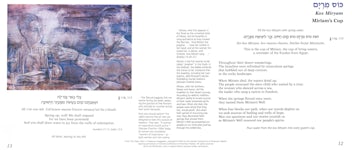
The Open Door includes traditional and innovative blessings, extensive commentaries and supplemental readings, contemporary additions like Miriam's Cup, women's and men's voices in gender inclusive language, more than 40 pages of traditional and newly commissioned music, and magnificent full color art.
Preface Introduction Preparing Our Homes and Hearts
The Seder Welcoming All to the Table—Kabbalat Panim Kindling the Festival Lights—Hadlakat Nerot Blessing the Children—Birkat Y’ladim Miriam’s Cup—Kos Miryam Order of the Seder—Seder HaSeder ● First Cup of Wine—Kadeish ● Hand-washing—Ur’chatz ● Greens—Karpas ● Dividing the Middle Matzah—Yachatz ● The Telling Begins—Magid The Seder Symbols—Pesach, Matzah, Maror In Every Generation—B’chol Dor Vador Songs of Praise—Hallel Second Cup of Wine—Kos Sheini ● Hand-washing—Rochtzah ● Motzi/Matzah ● Bitter Herbs—Maror ● Hillel Sandwich—Koreich The Egg—Beitzah ● The Festival Meal—Shulchan Oreich ● Recovering the Hidden Afikoman—Tzafun ● Blessing After the Meal—Bareich Third Cup of Wine—Kos Sh’lishi The Cup of Hope—Kos Eliyahu ● Songs of Praise—Hallel Fourth Cup of Wine—Kos R’vi-i Counting the Omer—S’firat HaOmer Songs—Z’mirot ● Conclusion—Nirtzah
Music Birkat HaMazon (long form) Notes Contributors
The elements of the traditional seder mnemonic, Kadeish Ur’chatz, are marked with a round bullet ●.
Rabbi Sue Levi Elwell was the founding Director of the Los Angeles Jewish Feminist Center and first rabbinic Director of Ma’yan. Rabbi Elwell served the Union for Reform Judaism working with lay leaders and clergy to create and sustain healthy, inclusive, vibrant, and open-hearted communities and congregations. She served as a congregational rabbi in California, New Jersey, and Virginia, and taught at the University of Cincinnati, University of California, Los Angeles, LaSalle University and the Hebrew Union College–Jewish Institute of Religion. She is the editor of several books, among them The Open Door: A Passover Haggadah, published by CCAR Press in 2002. She also contributed to various publications, such as The Sacred Table: Creating a Jewish Food Ethic (CCAR Press, 2011), Lights in the Forest: Rabbis Respond to Twelve Essential Jewish Questions (CCAR Press, 2014), and The Sacred Calling: Four Decades of Women in the Rabbinate (CCAR Press, 2016). Rabbi Elwell currently serves as Scholar in Residence at Washington Hebrew Congregation, and lives in Philadelphia with her wife Nurit Shein, CEO of The Mazzoni Center, Philadelphia’s pre-eminent LGBT health center. Ruth Weisberg, artist, Professor of Fine Arts and former Dean at the USC Roski School, is currently the Director of the USC Initiative for Israeli Arts and Humanities, and the founder and President ofthe Jewish Artists Initiative of Southern California. She received the Printmaker Emeritus Award from the Southern Graphic Council International in 2015 and the Foundation for Jewish Culture’s 50th Anniversary Cultural Achievement Award in 2011. She has been the recipient of the Women’s Caucus for Art Lifetime Achievement Award, 2009, Doctor of Humane Letters, honoris causa, Hebrew Union College, 2001, College Art Association Distinguished Teaching of Art Award 1999, Visiting Artist at the American Academy in Rome 2011,1995, 1994, and 1992. Her degrees are from the Accademia di Belle Arti di Perugia, Italy and the University of Michigan. Weisberg has had over 80 solo and 190 group exhibitions, including a major exhibition at the Norton Simon Museum, Pasadena and a retrospective, at the Skirball Museum, Los Angeles as well as a solo exhibition at the Huntington in San Marino. She was included in the ‘I,You’,We’ exhibition at the Whitney Museum in 2013. Her 2015 exhibition “Reflection Through Time” at Jack Rutberg Fine Arts included publication of a book of the same name. Her work is in sixty major Museum collections including The Art Institute of Chicago; The Biblioteque Nationale of France, Paris; Istituto Nationale per la Grafica, Rome; The Los Angeles County Museum of Art, The Metropolitan Museum of Art, New York; National Gallery, Washington, D.C. and the Whitney Museum.Weisberg is represented by Jack Rutberg Fine Arts. www.jackrutbergfinearts.com.
"The new Haggadah exemplifies what Reform liturgy should be."--Rachel Adler, associate professor at HUC-LA